
Why you feel stuck.
5 steps to stop running in place

You have a great job on paper. Everyone tells you as much. The pay is good, the company is well known, and many apply each year hoping to get in. At family gatherings, the temporary validation feels nice. You convince yourself it’s not so bad after learning a distant cousin is struggling to even find a job. You feel a little guilty for having complained so much.
Then comes Monday.
The deadlines, the overwhelming workload, and the lack of light at the end of the tunnel comes tumbling in.
The internal civil war between being grateful for a job and feeling unfulfilled reignites and rages with fury.
As the stress and anxiety seeps into your every pore, your uncle’s voice echos in the subconscious - “You have such a great job, you should be proud of yourself!”.
Somehow, the validation doesn’t sound as convincing when its played back in your own head.
As the anxiety reaches a boiling point, you seek to relieve some pressure. For a split second you entertain the possibility of quitting, walking away, and letting everything else burn.
But the relief didn’t last long. Reality slaps you across your face reminding you why you can’t quit.
You’ve got bills to pay. You don’t have the savings. (And even if you did, inflation is high and there’s an affordability crisis going on; or so you’ve heard.) You don’t have additional streams of income because you were too shy to dance on Tik Tok 3 years ago. You want to quit but you can’t. Everyday is a grind and the temporary social validation that felt nice the during the family gathering goes out the window.
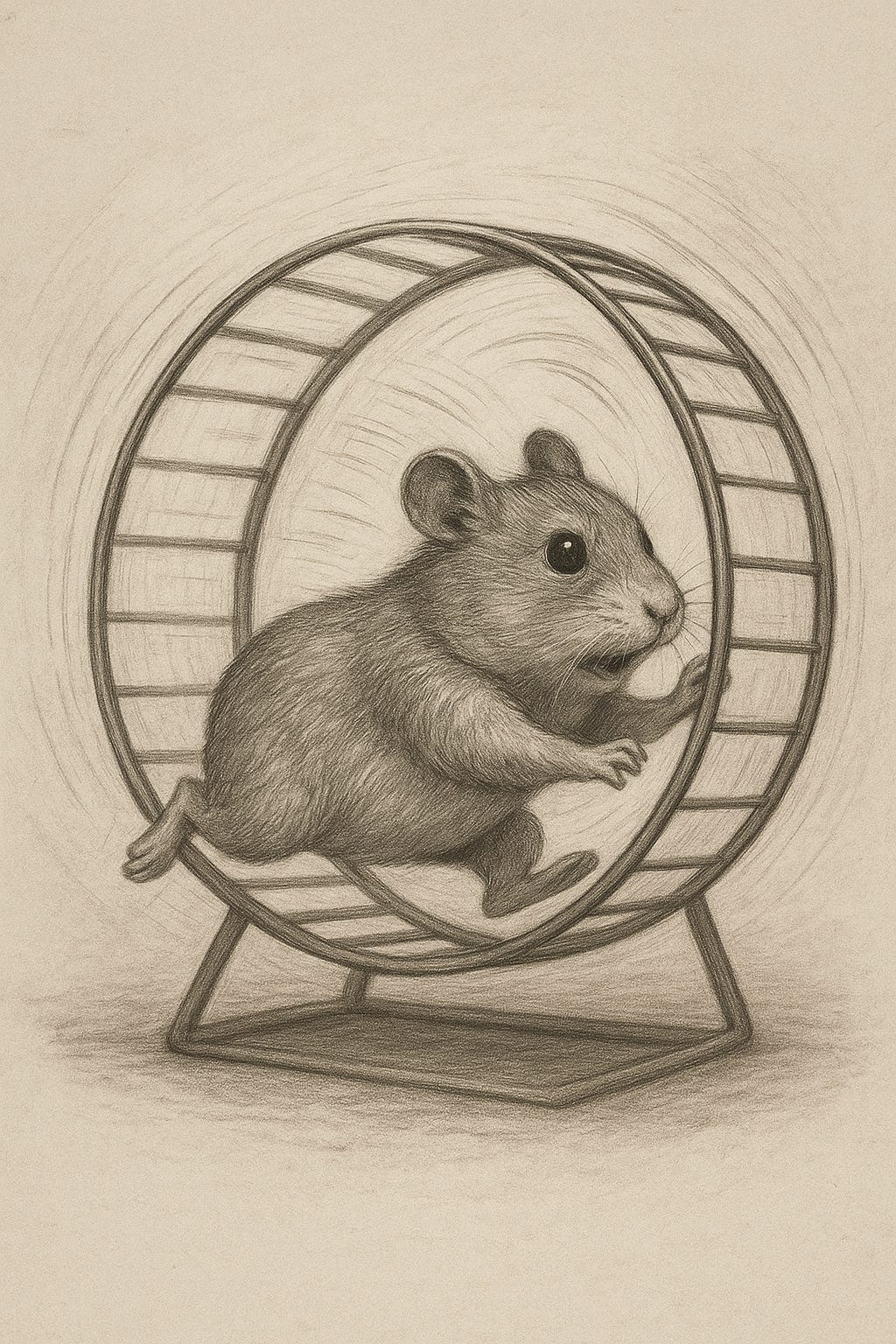
You feel stuck. Like a mouse trapped inside four walls with no windows. Inside this enclosed space, a wheel awaits for you to run in place. Forever.
I’ve experienced that feeling before. I’ve also felt other types of feeling “stuck”. There’s been times when work feels mundane and I felt like I was wasting my time. There were also times when work is difficult and everyone was zooming past me making me feel inadequate.
The commonality in all of these experiences is that I felt stuck. Humans can eat shit and push past challenges. But only if they know why they’re doing it and that there’s a finish line. However, when the horizon seems to extend forever, the motivation is all but gone.

So what do you do? How do you “unstuck” yourself?
Well, if the problem is that you don’t know why you’re doing something you don’t like, and how long you have to keep doing it, the inverse of that should solve your problem.
In other words, understand why you’re enduring the job and how long you have to keep enduring it for.
Create that light at the end of the tunnel for yourself.
Here’s 5 steps that has helped me:
1. Audit your current situation
Why don’t you like your job? Spend the time to break down your job. Is it the work hours, the work load, or the actual work itself? Or is it your boss, your coworkers, or the organization’s culture in general? Take the time to really break down your job into little components and assess how much you like or dislike each component.
You can also ask yourself a hypothetical: If a genie could grant you the wish to give you the exact life you want at the snap of a finger, so long as it doesn’t defy the laws of physics, what would that life look like? This can help you tease out the gaps between what you want and your current situation.
2. Brainstorm solutions
Once you have a good idea of the problem — the issues and their severity — you can start brainstorming solutions to counteract and solve those problems.
If the issue is a combination of workload and toxic work environment, then maybe a solution can be to switch teams if the company is big enough and allows for that. If not, it’s time to brush up the resume. If the issue is simply the workload, maybe a conversation with the manager can clear it all up. If you simply dislike working for someone, the solutions might lean more towards finding freelance work on the side, saving aggressively for retirement, or some alternative income source that gets you out of the corporate grind.
3. Understand and accept the costs
Each of the solution you list out will have a price tag.
Changing jobs require time and effort to polish your resume, apply to jobs, prepare for interviews, and actually going through the interviews. Anyone who’s gone through this understands this can become another full time job.
Working on a side hustle means working your current job for a few more years while you build up that side hustle. It also means pushing past boring periods and most likely working more and getting paid less in the beginning.
The biggest mistake is to get excited about a solution without understanding the cost. You don’t want to start on the solution and give up half way because you didn’t realize what was required to actually succeed with it.
After assessing the costs, you can make the decision on which solution, if any, is worth pursuing.
4. A word of caution
It is possible that all the solutions’ costs are too high leaving you back at square one and feeling stuck. I’ve been there before — I thought the side hustle will take too long, saving for retirement will take too long, finding another job might be marginally better but not worth the cost of applying etc.
At this point, you can really dive into the solutions more. Are there ways you can scope down the solutions to reduce the costs? Instead of hoping a side hustle can replace your salary, what if it just covered your expenses? Instead of hoping for a less stressful job that paid the same, what about a less stressful job that paid slightly less?
If the costs are still too high after this negotiation, then I’m sorry but I need to state the harsh truth. The problem is you. I don’t say this to be offensive but facing this is the only way that has helped me get past it. If the costs of the solutions are too high, then either the current job you have isn’t really that bad, or you are just not willing to work for the things you want.
5. Chart a course
Assuming you found a solution that makes sense to you, fixate solely on that solution and put everything else in the back pocket. With that single solution in hand, you want to dedicate all your energy into making that solution a reality.
Contrary to popular advice, don’t plan too much and just start. As an over-planner myself, I tend to want to plan out every detail. It’s a waste of time because detailed plans always change down the road anyways.
You have your direction. It’s now time to churn out proof-of-concepts that you can iterate on over time. This becomes your “plan”.
Hopefully, by the end of this exercise, you will have a goal on the horizon to look forward to. You know you’re enduring your current job just to keep the lights on for now while you work towards that goal. You’ll still feel the dread but it’ll feel a little bit more bearable, hopefully.
The act of thinking through these steps usually give me some relief because I start to see some hope in what I thought was a limitless, barren, horizon. Starting is the next challenge, and then persisting is the one after that. If you can start and persist, you will certainly get to your goal. Whenever you feel like quitting, just go back to the first step and remind yourself why you started this journey in the first place — to get unstuck and live a life you truly want.
This is one of your best posts yet!